
Press Kit

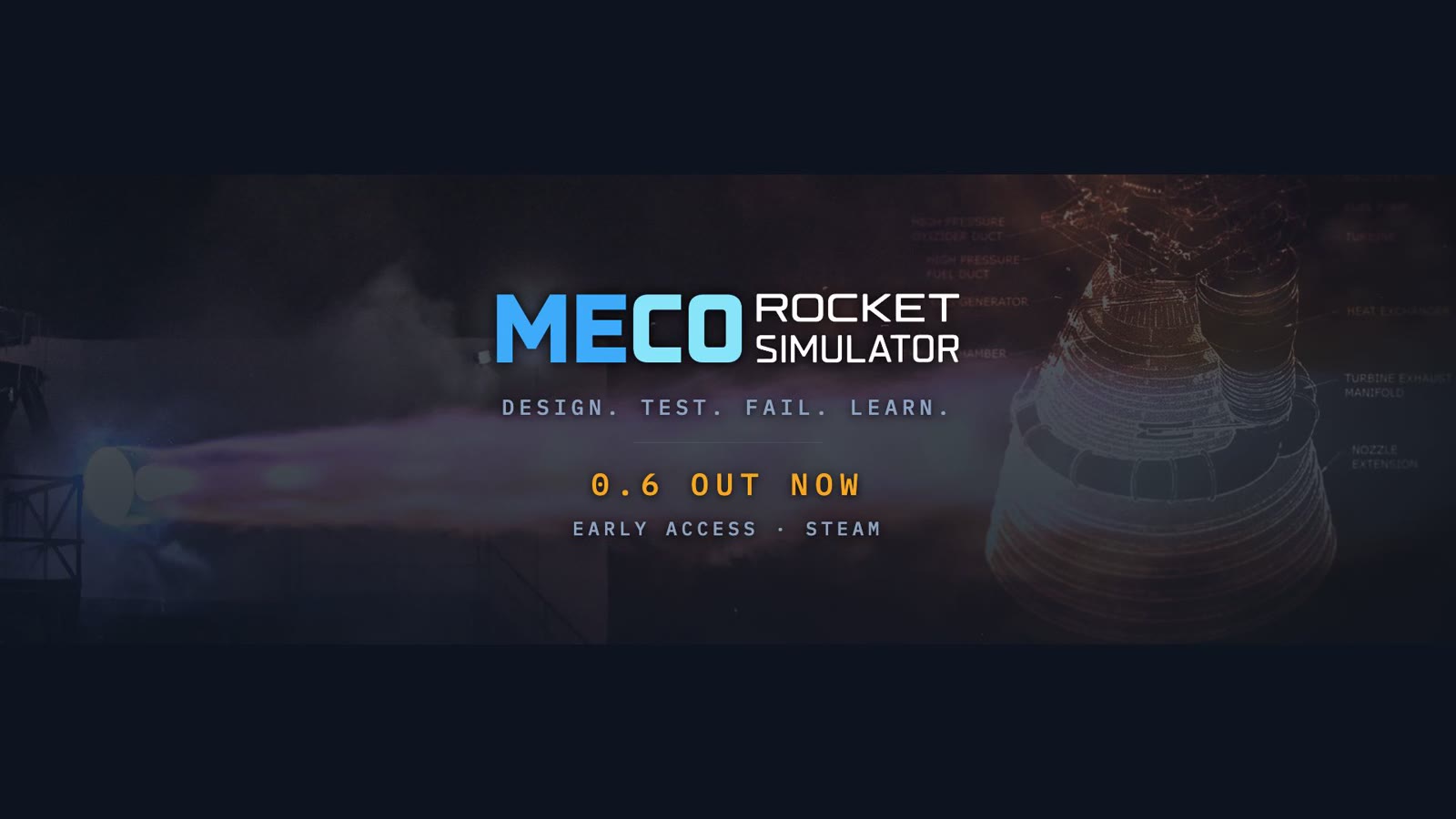
Meco Rocket Simulator is a rocket engine design simulator. You set the geometry of a real engine, fire it, and read what comes back on live graphs. Every node is inspectable, and nothing important happens in a box you cannot open.
It has been on Steam Early Access since 14 July 2025. The current release is 0.6.1. It is built by one person, Dannie Sim, at Loren Aerospace Ltd in London.
Quick facts
- Title: Meco Rocket Simulator
- Developer and publisher: Loren Aerospace Ltd, London, United Kingdom
- Team size: one
- Platforms: Windows and macOS. Linux coming soon
- Release: Steam Early Access, 14 July 2025
- Review keys: available on request, email admin@mecorocketsimulator.com
- Creators and press: apply for a free 12-month Meco licence on the creator and press licence page. It covers the Windows and macOS installers
- Current version: 0.6.1, 30 August 2026
- Genre: rocket engine design simulator, single player, no combat
- Optional add-on: Pro DLC, with the soundtrack, technical reference PDFs, 3D-printable component models and wallpapers. It contains no gameplay.
- Price: shown live in the Steam block below, read from Steam at build time. Early Access pricing steps up as the roadmap fills in, so quote the figure on the store page rather than this page if you are writing ahead of publication.
- Contact: admin@mecorocketsimulator.com
Three things that make it worth a look
The thrust number comes from the flow field, not a lookup table
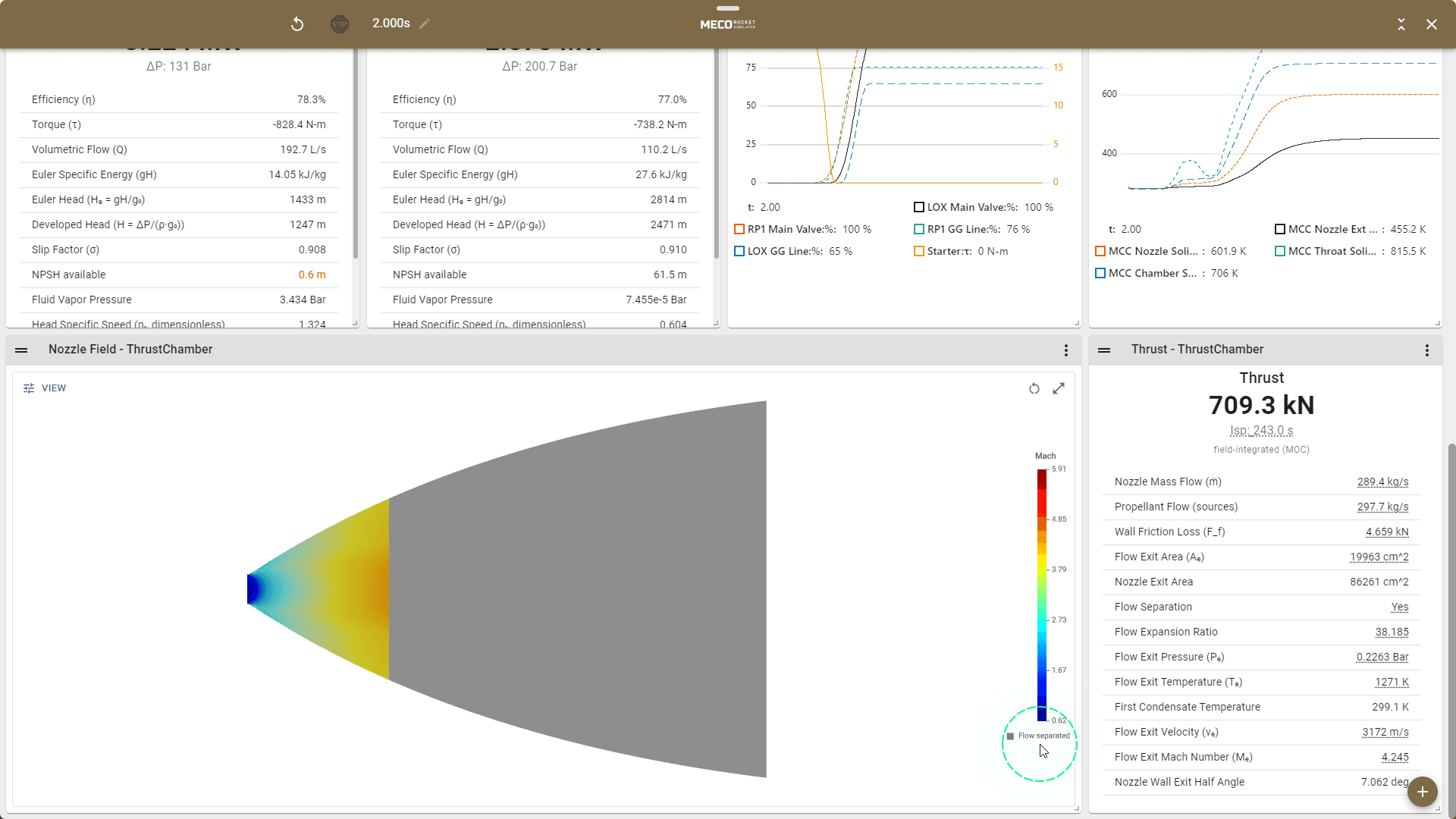
Meco integrates the method-of-characteristics flow field through the bell you designed, at the mass flow the simulation actually delivered. Push the expansion ratio too far at sea level and the flow lets go of the wall. The field view grays out from the separation point onward, and thrust is counted only where the flow is still pushing.

The hardware builds itself from a handful of numbers
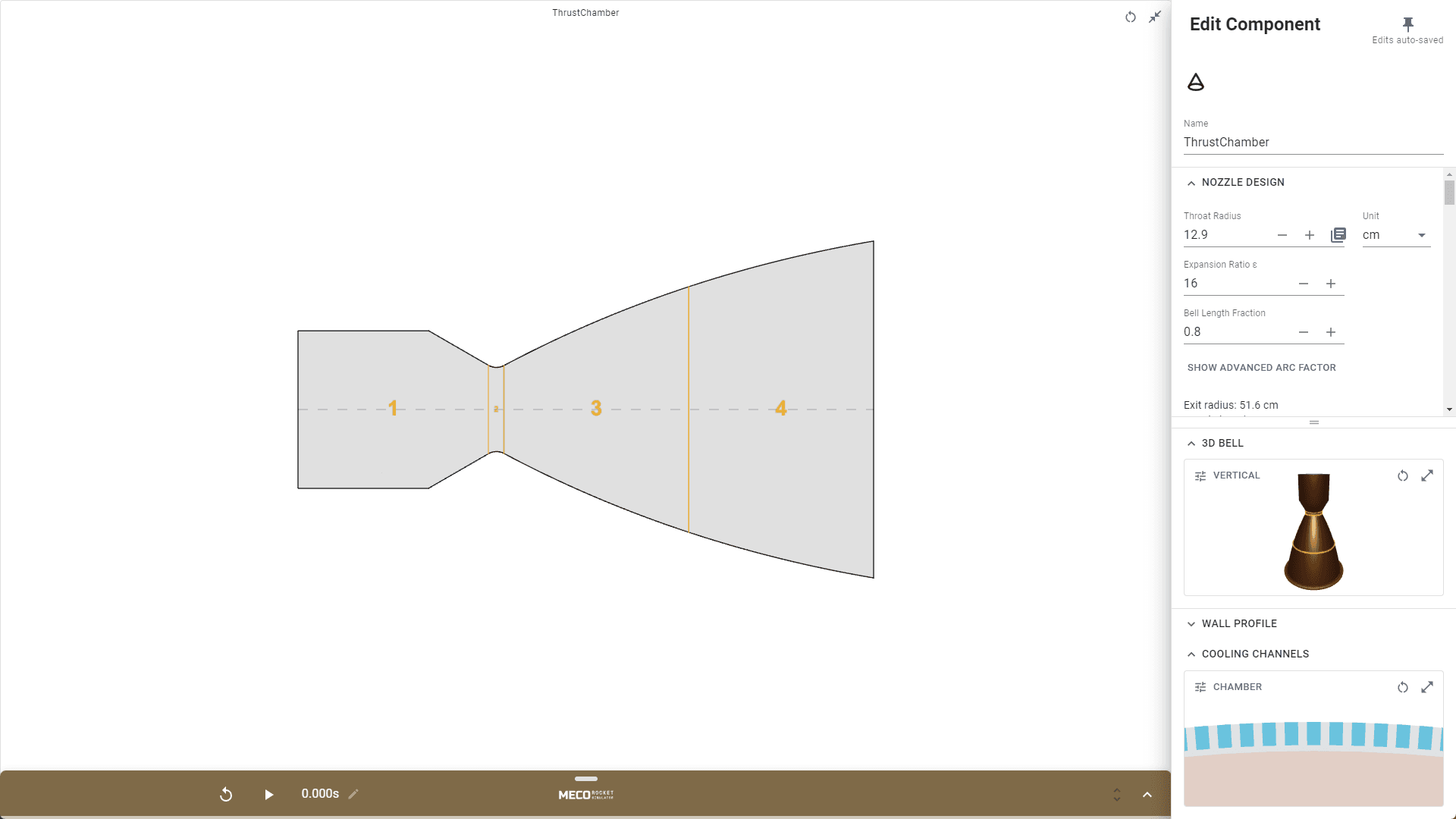
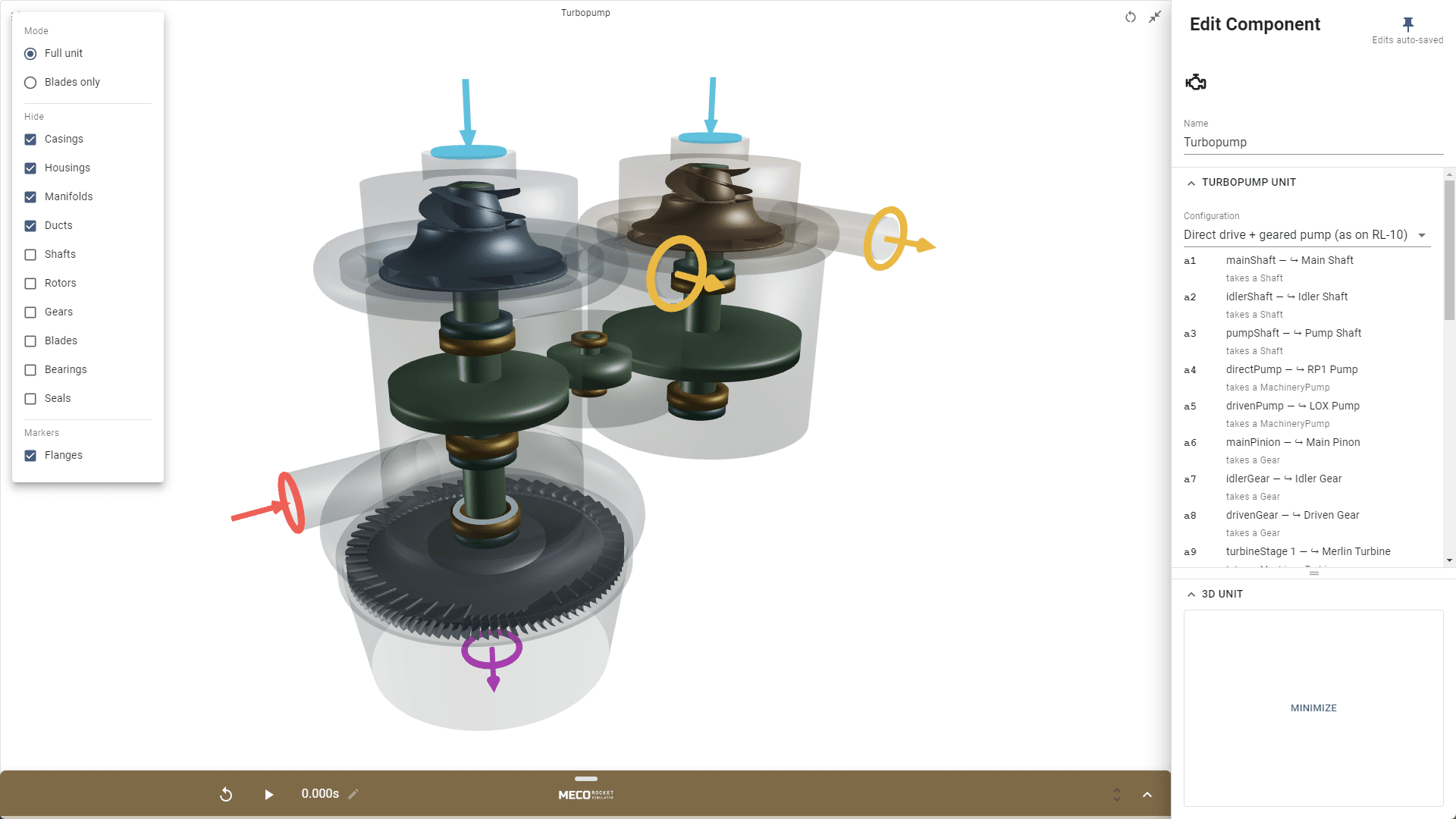
Give the Thrust Chamber a throat radius, an expansion ratio, a contraction ratio, a chamber length and a section count. It returns a Rao thrust-optimized bell, the regenerative cooling channel layout and the chamber solids in 3D. Change one headline number and the hardware rebuilds while you watch. The Turbopump does the same for shafts, gears, pumps and turbines across four shaft layouts.


The engine model is published, with a DOI
The coupled gas-generator engine model behind the simulation is written up in a public paper, demonstrated on the Merlin 1D, so a reader can check the work rather than take it on trust: 10.5281/zenodo.21864769.
Two more numbers for the record. The solver advances the state of the engine 50,000 times for every second of engine time, at a fixed step. And the built-in Vulcain 1 model sits on its published performance figures: an automated test holds its engine Isp within 1% of the published 431 seconds.
How you play it
Assemblies are parts of an engine, not the engine. On the node graph canvas you drop in components, wire them together and run. Domes, injectors, valves, cooling joints, gas generator, turbine. It is your plumbing, and it fails in your handwriting.

The start is a schedule too. One master ramp runs 0 to 1, and each valve fires as it crosses its own threshold, with its own level, width and delay. Real engines go in order: spin up, crack the valves, light the gas generator, trim.

There are fourteen missions across five chapters. Mission 0 drops the player at senior engineer Miku Aoyama's workstation with her Vulcain 1 model open and a clear instruction not to touch it. Chapter V opens with the engine that flies Falcon 9.
Your first designs probably will not hit their targets. That is the point. In a mission, when a build misses, a "Need a hint?" diagnostic names the specific problem and walks you to the fix one item at a time. In free build there is no tutor. There it is you, the graphs and the hardware rebuilding as you type.

What shipped in 0.6
0.6 arrived on 26 August 2026, and the 0.6.1 patch on 30 August.
- Engine assemblies. The Thrust Chamber builds a Rao thrust-optimized bell and tiles its regenerative cooling channels from a handful of inputs, live in 3D. The Turbopump sizes its own shafts and gears across four shaft layouts.
- Mission 13, Historical Recreation: SpaceX Merlin 1D. The first mission of Chapter V, and the capstone of the fourteen. The debrief walks back through the startup you authored and the propellant flows and chamber pressure you tuned it to. Afterwards the Merlin 1D is a free-build template, yours to keep tinkering with.
- Chained startup control. One master ramp drives every valve on its own threshold, level, width and delay.
- Undo and redo, across the editor.
Playable now: Chapters I to IV complete, Chapter V open with the Merlin 1D. Thrust Chamber and Turbopump assemblies in live 3D. Engine Isp, the number real datasheets quote, with the gas generator's propellant counted against it.
Building next: the rest of Chapter V, the A-7 Redstone and the Vulcain 1. The Injector Head assembly in coaxial, pintle and impinging configurations. Expander-cycle components. The whole engine joined into one machine in 3D. Component mass, for thrust-to-weight numbers. Thermal and load stress limits. The roadmap is intended to finish in 2027.

Who it is for
Propulsion-obsessed tinkerers, amateur rocketeers, university rocket clubs, and aerospace and mechanical engineering students. It is not a casual space game. It is an engineering sim with a real learning curve, and it is at its best when you want to know why a cycle works.
What players are saying
Verbatim from Steam reviews.
If you have an interest in the design and function of rocket engines this is the game for you! Complicated and in-depth, this game is closer to a simulation software than a video game, and tackles the complex principles and math behind propulsion engineering.
Rigel the Protogen
I love this game! it is the first software i could find that gives you access to this kind of rocket simulation thats not blocked to the greater public. although it is a steep learning curve, there is a great community around it and plenty of people willing to help.
iset07wick
As a mechanical engineering student, I enjoy learning a lot about rocket science from this game as it reminds me of the concepts ive learned in my propulsion and turbomachinery classes where thermodynamics, fluid mechanics, heat transfer and some concepts of mechanical design are implemented into rocket design.
CGlassMan
This game, or i would like to call it more a "Tool" is great for someone who like's to understand more physics (fluids/ dynamics/ etc..) and micro physics related to engines.
HTK
Press assets
Video and streaming. You can record, stream and monetize video of Meco Rocket Simulator anywhere you like. No permission needed, no revenue share, and nothing to sign.
The assets below are free to use in coverage, in print, online and in video, with credit to Loren Aerospace Ltd. Screenshots and trailer footage can be cut, cropped, captioned and edited into your piece, music included. Logos and artwork are crop and scale only: no recolouring, no redrawing.
Trailer
Screenshots, 1920 x 1080 PNG
- Thrust Chamber editor and Rao bell
- Nozzle flow field with separation
- Turbopump assembly in 3D
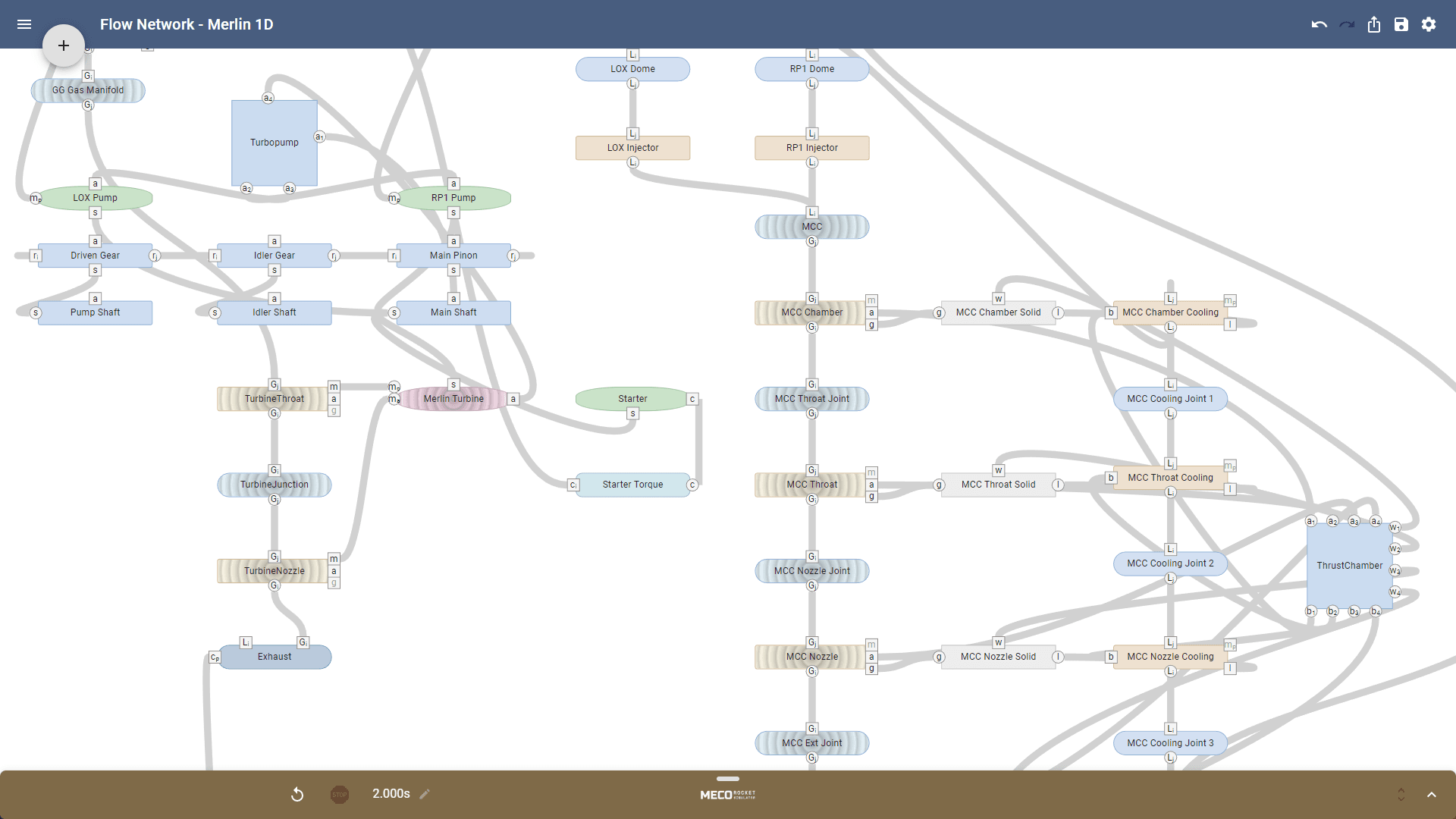
- Merlin 1D flow network on the node graph
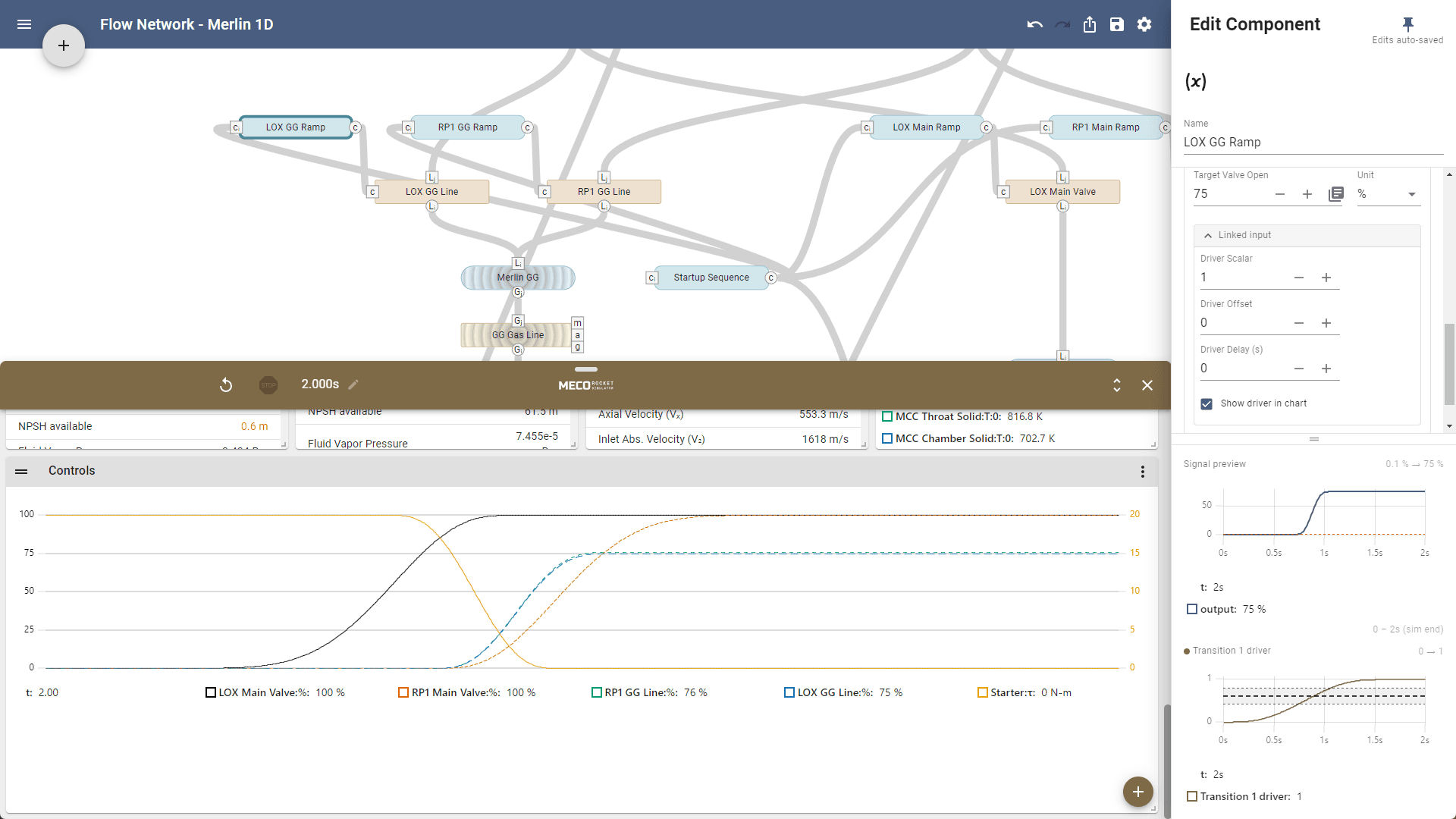
- Startup schedule and live controls chart
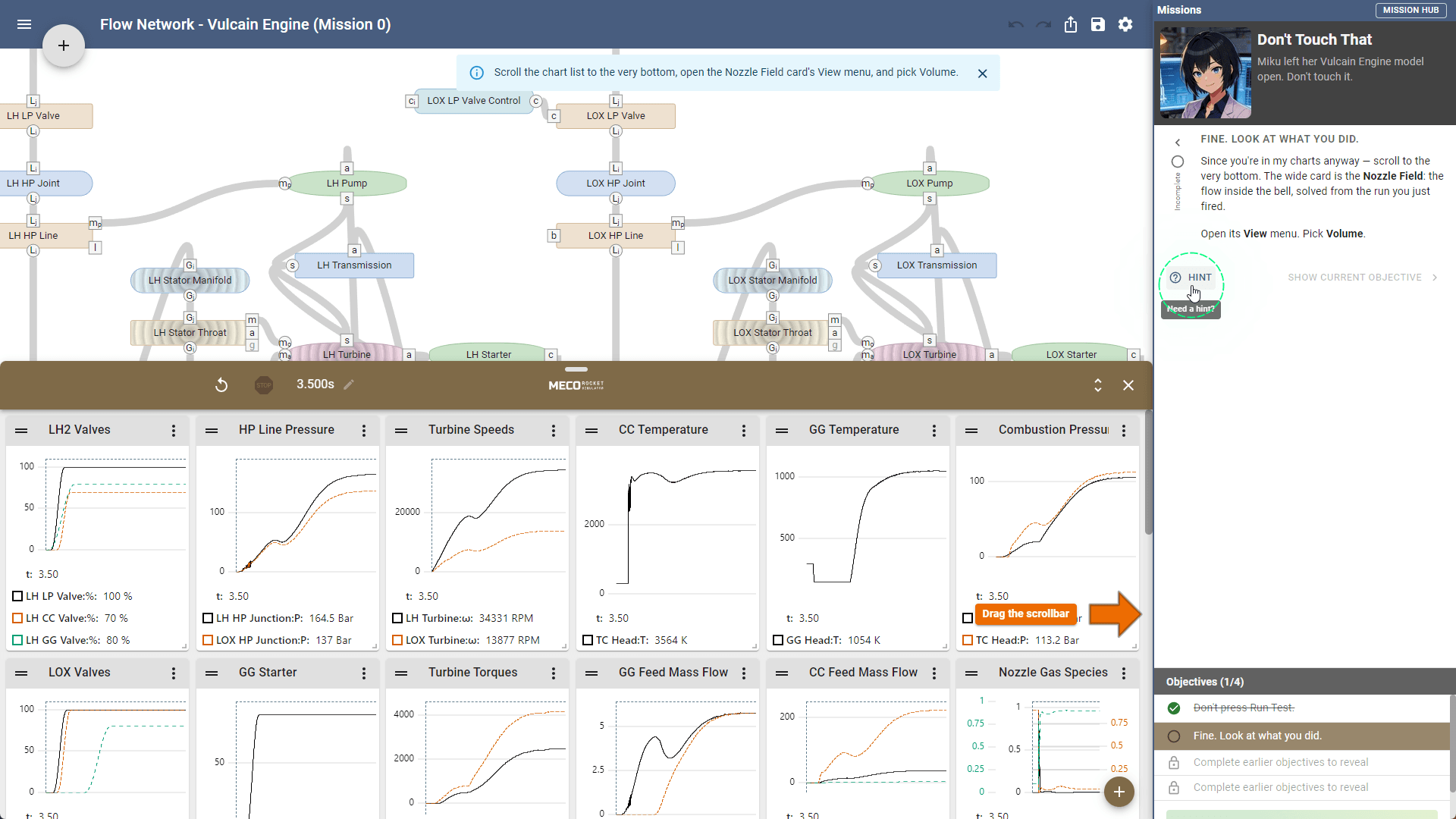
- Mission 0 with the hint diagnostic
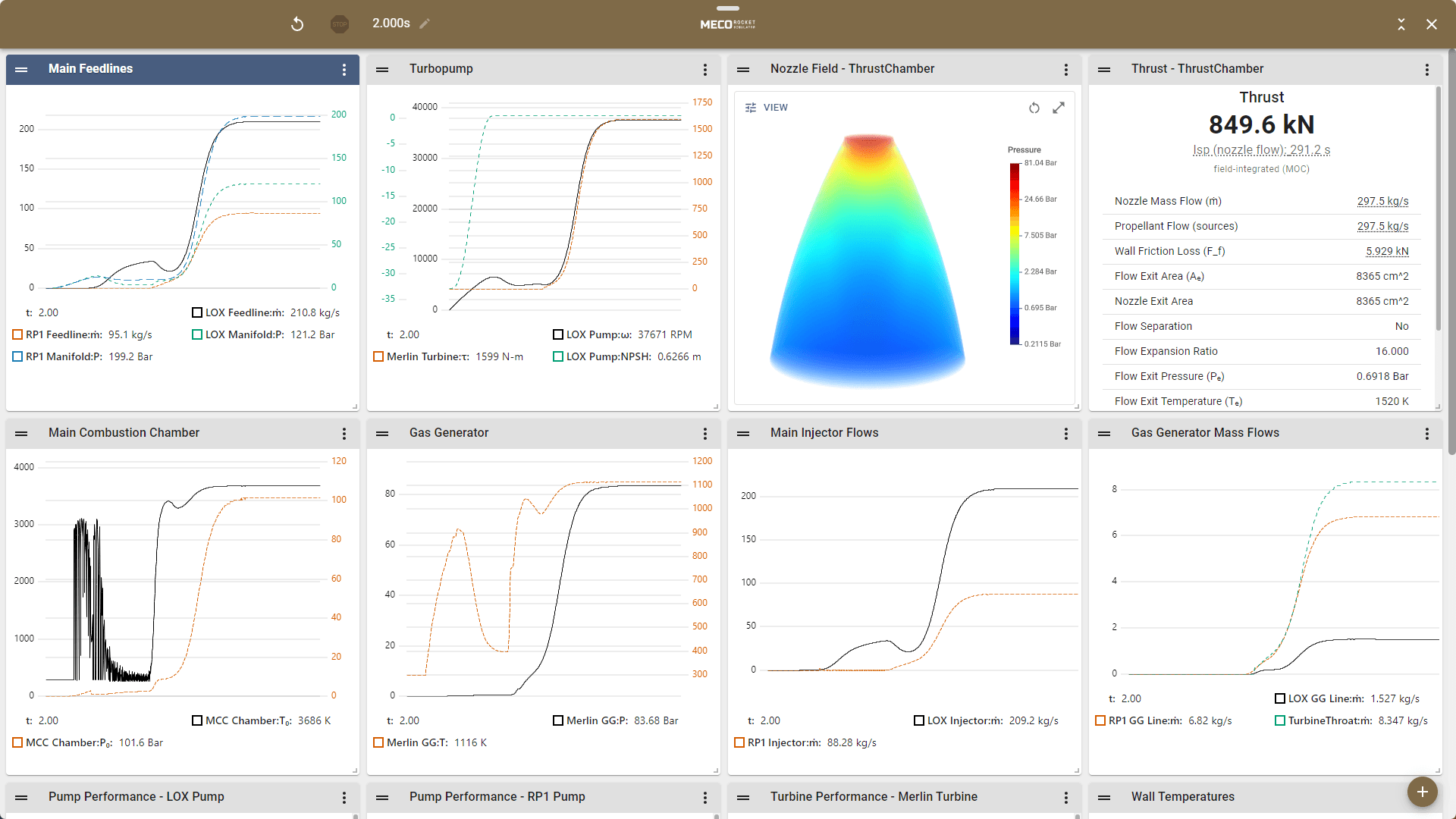
- A converged Merlin 1D run
Logos

- Meco banner wordmark, transparent SVG
- Meco square logo, gray, 1024 x 1024 PNG
- Meco square logo, full color, 1024 x 1024 PNG
- Loren Aerospace logo, mono, 475 x 139 PNG




For anything not listed here, including higher-resolution art or raw footage, email admin@mecorocketsimulator.com.
About Loren Aerospace

Loren Aerospace Ltd is a company registered in England and Wales, number 14563299, at 71 to 75 Shelton Street, Covent Garden, London, WC2H 9JQ. It was founded by Dannie Sim, who spent 25 years in technology startups, in scientific publishing, and in games at Activision Blizzard on Candy Crush and at Sony PlayStation on Spider-Man 2. He builds Meco alone.
Loren Aerospace develops Meco Rocket Simulator and LorenSim, the simulation library underneath it, which is published for non-commercial and academic use.
To be a spacefaring civilization we need a lot of people who can build and maintain rocket engines. That is a teaching problem before it is a hardware problem, and Meco is the answer to it that one person can build.